Watercare vs You: Who Pays for Blocked Drains?
Blocked drain in Auckland? Work out whether it’s Watercare’s problem (free fix) or yours before you spend a cent — plus how to claim a leak allowance.
Need a plumber now?
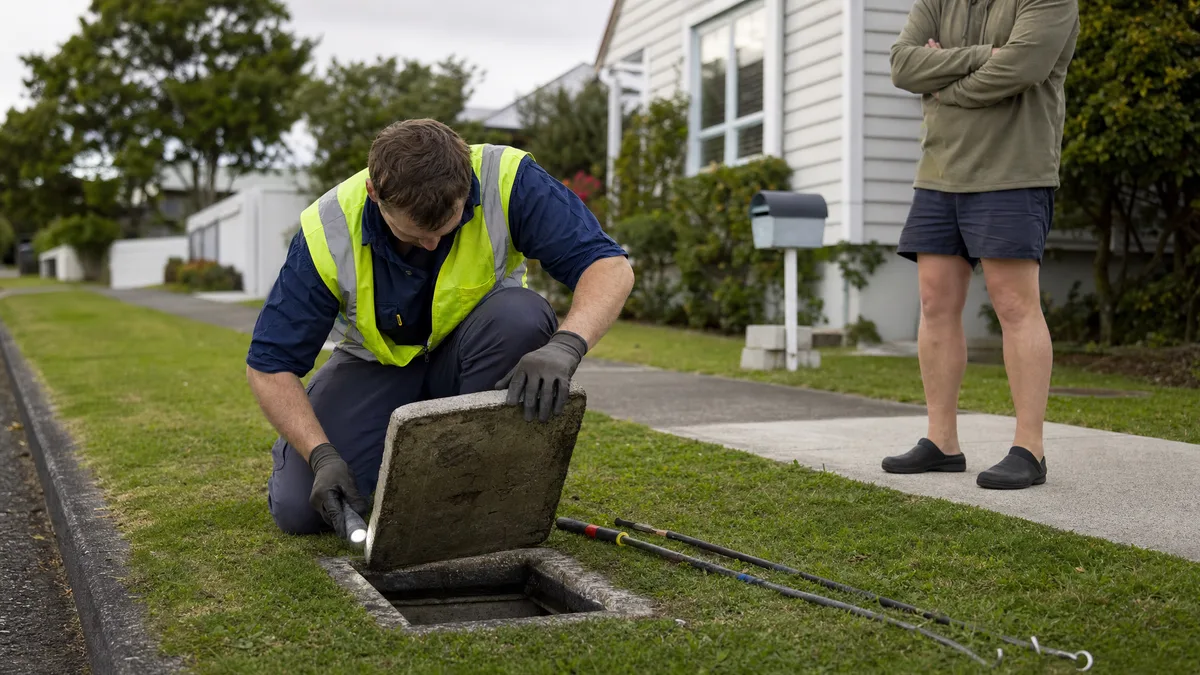
Here is the mistake that costs Auckland households hundreds of dollars every week: sewage starts surfacing, they panic, they call the first drainlayer who answers, and they pay $150–$450 to clear a blockage that was never theirs to fix. If the problem is in the public network, Watercare clears it for free — you just have to know which side of the line the fault sits on. This guide shows you how to tell in about two minutes.
Who owns which pipes in Auckland?
The split is simpler than most people think:
- Watercare owns and maintains the public wastewater network — the mains under the street, public manholes, and the shared pipes that carry sewage away from your property. It also owns the water supply network up to and including the toby (the small street-side valve and meter box at your boundary).
- You (the property owner) own the private drains — everything on your section, from your gully traps and toilet connections down to the point of connection with the public network. That point is usually at or near your boundary, but on older Auckland sections it can sit inside a neighbouring property.
- Auckland Council’s Healthy Waters team handles the public stormwater network — the roadside catchpits, public stormwater mains and overland flow paths. Your private stormwater downpipes and drains are, again, yours.
The rule of thumb: private pipes on your side of the point of connection are your bill; anything past that point belongs to Watercare (wastewater) or Auckland Council (stormwater), and they fix their own assets at no charge to you.
How can I tell if the blockage is mine or Watercare’s?
You usually do not need a camera to make the first call — you need to look at where the wastewater is coming up:
- Overflowing gully trap on your section, gurgling toilets, one slow house — the blockage is almost certainly in your private drain. The gully trap is designed to be the overflow relief point, so waste surfaces there before it backs up into your shower. This one is yours: call a drainlayer.
- Sewage surfacing from a public manhole, in the street or berm — that is the public network. Call Watercare’s 24/7 faults line (the number is on watercare.co.nz and on your water bill). It is free, they respond around the clock, and reporting overflows quickly matters because raw sewage reaching a waterway is a public health issue.
- Several neighbouring houses backed up at the same time — a strong signal the fault is in the shared public main, not your private drain. Again, Watercare first.
If it is genuinely ambiguous, call Watercare first anyway. The worst case is they inspect, find the fault on your side, and tell you to get a private drainlayer — which costs you nothing but an hour or two. Doing it in the other order can cost you a callout fee for a blockage that was never yours.
What about shared drains that cross property boundaries?
This is where older Auckland suburbs get messy. Plenty of pre-1970s sections — and most cross-lease and infill developments — have shared private drains: one pipe serving two or more properties before it reaches the public network. Two things to know:
- A shared private drain is typically the joint responsibility of the properties it serves, up to the point of connection. If it blocks, the owners generally share the repair cost — regardless of whose section the pipe physically runs under.
- Your private drain may run through a neighbour’s property before connecting. You are still responsible for it. Auckland Council holds historic drainage plans for most properties, and a drainlayer can pull them — worth doing before anyone starts digging.
If a neighbour disputes whose blockage it is, do not argue from vibes. Get evidence — which brings us to the camera.
Is my problem stormwater or wastewater? (It changes who you call)
Aucklanders mix these up constantly, and it sends them to the wrong organisation:
- Wastewater = anything from toilets, sinks, showers, laundry. Public network faults go to Watercare.
- Stormwater = rainwater from roofs, driveways and roads. Public network faults — a blocked roadside catchpit, flooding from a public stormwater main — go to Auckland Council (Healthy Waters), via the council’s report-a-problem channels.
If your lawn ponds every time it rains but the drains inside the house run fine, that is a stormwater problem. If it smells, it is wastewater. On older properties the two systems are sometimes illegally cross-connected — a common find during a CCTV drain inspection, and something you will want fixed before it becomes a compliance issue at sale time.
What does a CCTV inspection actually prove?
When responsibility is disputed — you vs Watercare, you vs a neighbour, you vs the previous owner — a CCTV drain camera is the evidence that ends the argument. A camera survey (typically $250–$500 in Auckland, depending on drain length and access) gives you:
- The exact location of the fault, measured in metres from the access point — so you can say precisely whether it sits before or after the point of connection.
- The cause — tree root intrusion, a collapsed earthenware pipe, a sagging (bellied) section, fat build-up, or a foreign object.
- A recording you can hand to Watercare, your insurer, a neighbour or the Disputes Tribunal. Watercare’s own crews use camera footage the same way; if their inspection shows the fault on the public side, they fix it at their cost.
If a drainlayer quotes you thousands for excavation without camera footage showing you the fault, ask for the footage first. Any competent operator has the gear. Our blocked drains hub lists Auckland drainlayers who do camera work, and the price guide covers what clearing and repairs typically cost.
Can I get a leak allowance on my water bill?
The other half of the “who pays” question is water leaks. If a hidden leak on your private pipework — say, the underground supply pipe between the toby and your house — runs for weeks before anyone notices, the water that escaped still goes through your meter, and the bill can hit four figures.
Watercare operates a leak allowance (remission) scheme for exactly this situation. The essentials:
- It applies to hidden leaks — ones you could not reasonably have detected, typically underground or under slab. A dripping tap or a running toilet you ignored for a month will not qualify.
- Fix the leak first. The allowance is applied after repair, not before.
- Keep the plumber’s invoice. It is your proof of the repair date and the nature of the fault, and Watercare will ask for it.
- Allowances are generally limited — typically around one per property within a set period — and the credit usually covers a portion of the excess water charges, not your normal usage.
Suspect a hidden leak? The quick self-test: turn off every tap and water-using appliance, then watch your meter at the toby for a few minutes. If it is still ticking over, water is escaping somewhere. A leak detection specialist can locate it acoustically without digging up half your lawn — and the sooner it is found, the smaller both the water bill and the repair.
The 60-second decision tree
- Sewage at a public manhole, street, or multiple houses affected? → Watercare faults line. Free.
- Overflowing gully trap or backup inside your house only? → Your private drain. Call a drainlayer via our blocked drains page.
- Rainwater flooding, no smell? → Stormwater. Public side goes to Auckland Council; private side is your plumber or drainlayer.
- Disputed responsibility? → CCTV inspection before anyone digs.
- Big water bill from a hidden leak? → Repair, keep the invoice, apply for Watercare’s leak allowance.
Two minutes of triage, and you only pay for the faults that are actually yours.
Burst pipe? No hot water?
Compare licence-checked Auckland plumbers — 24/7 emergency options flagged, honest price guides published.
Need a Plumber You Can Trust?
Every listing in our directory is checked against the PGDB register before it goes live — compare licence-checked Auckland plumbers with honest price guides.